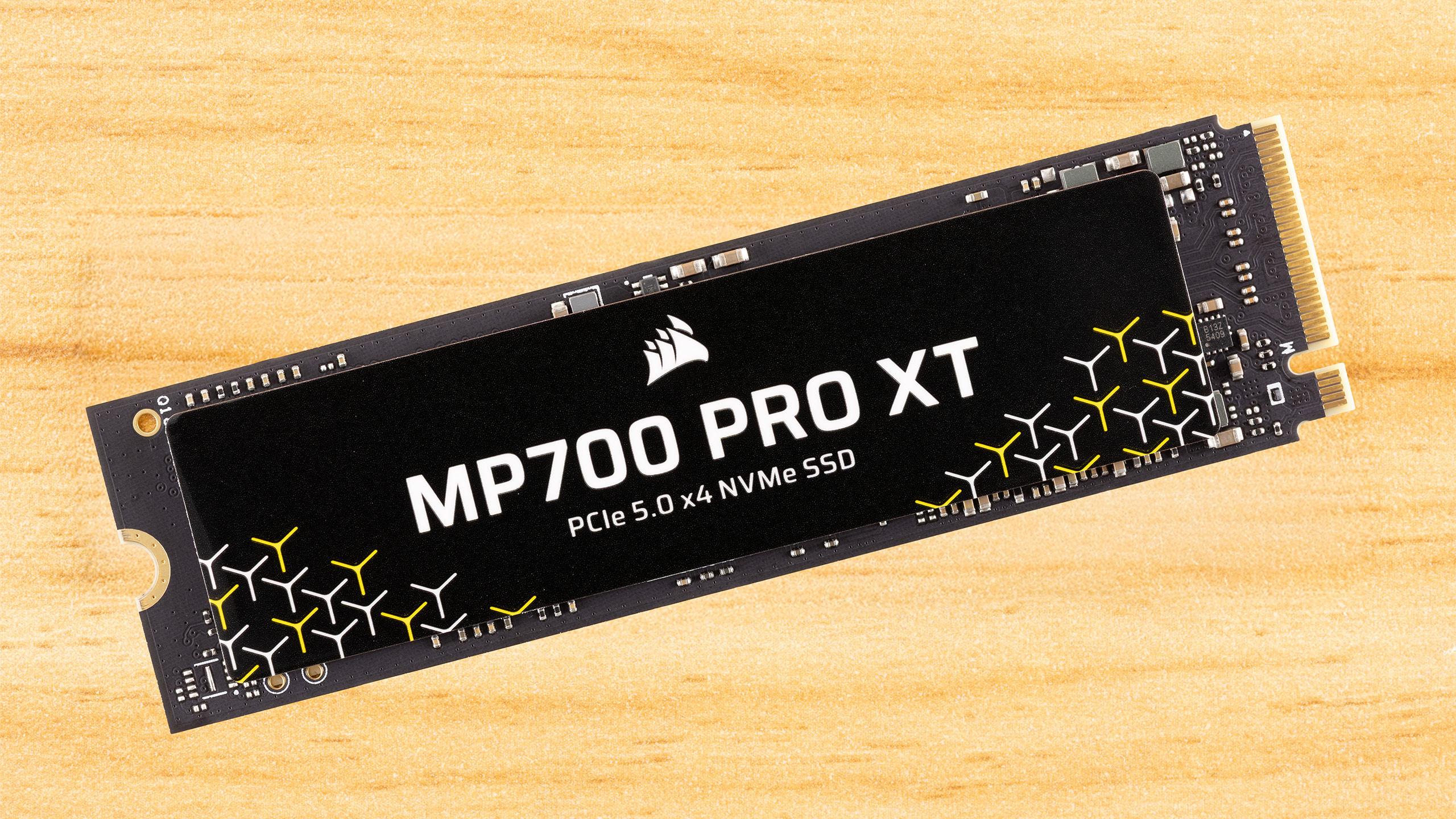
Tom's Hardware Verdict
The Corsair MP700 Pro XT is the fastest, most power-efficient SSD we’ve tested to date.
Pros
- +
Excellent all-around performance
- +
Very good sustained performance
- +
Class-leading power efficiency
Cons
- -
No 8TB SKU at launch
Why you can trust Tom's Hardware Our expert reviewers spend hours testing and comparing products and services so you can choose the best for you. Find out more about how we test.
Every once in a while, a product comes along that causes you to do a double-take. Oh, another high-end SSD, but wait! It delivers a record 3.3 million IOPS? It’s how power-efficient? The relatively plain-looking Corsair MP700 Pro XT knows how to surprise by turning the existing order of things on its head. In a time when we finally have some great high-end drives, it manages to raise the bar even further in a way that previously seemed improbable. Almost 15 GB/s with truly zero compromises? That reality is here.
Many of our expectations are built around Phison’s original high-end PCIe 5.0 SSD controller, the E26. This was an incredible innovation for its time, but it locked in a certain perspective on drives in this class – they are power-hungry, high-running storage solutions made only for enthusiasts. It’s hard to find a tech forum where users haven’t complained about the need for active cooling, even though it is not strictly required. That is, until SMI’s SM2508 controller arrived. When combined with the right flash it delivered new levels of performance with far less power consumption. Our sample didn’t even come with a heatsink. In retail, the SanDisk WD Black SN8100 in particular set the new baseline. Phison was, for once, not the one to make the first move, but taking the time to optimize its hardware has really paid off. The MP700 Pro XT proves that beyond any doubt.
Excellent 4KB random read performance? Check. Solid sustained write performance? Also check. Fantastic power efficiency so that the drive can be used anywhere? You know it. Even the launch pricing is reasonable, although current market turbulence makes that more difficult to judge. This drive has no weaknesses, and it impresses us across the board. Sure, there’s no 8TB model yet available, but if you want it at any other capacity, it is probably the best choice right now. We’re certainly eager to see what the competition brings out with this new hardware, but for now, diving into the MP700 Pro XT is an exciting prospect.
Corsair MP700 Pro XT Specifications
|
Product |
1TB |
2TB |
4TB |
|---|---|---|---|
|
Pricing |
|||
|
Form Factor |
M.2 2280 |
M.2 2280 |
M.2 2280 |
|
Interface / Protocol |
PCIe 5.0 x4 NVMe 2.0 |
PCIe 5.0 x4 NVMe 2.0 |
PCIe 5.0 x4 NVMe 2.0 |
|
Controller |
Phison E28 |
Phison E28 |
Phison E28 |
|
DRAM |
LPDDR4x |
LPDDR4x |
LPDDR4x |
|
Flash Memory |
Kioxia/Sandisk 218-Layer TLC (BiCS8) |
Kioxia/Sandisk 218-Layer TLC (BiCS8) |
Kioxia/Sandisk 218-Layer TLC (BiCS8) |
|
Sequential Read |
14,900 MB/s |
14,900 MB/s |
14,900 MB/s |
|
Sequential Write |
14,200 MB/s |
14,500 MB/s |
14,700 MB/s |
|
Random Read |
1,500K IOPS |
2,700K IOPS |
2,700K IOPS |
|
Random Write |
3,300K IOPS |
3,300K IOPS |
3,300K IOPS |
|
Active Power |
6.2W |
6.2W |
6.5W |
|
Endurance (TBW) |
700TB |
1,400TB |
2,800TB |
|
Part Number |
CSSD-F10GBMP700PXNH |
CSSD-F20GBMP700PXNH |
CSSD-F40GBMP700PXNH |
|
Warranty |
5-year |
5-year |
5-year |
The Corsair MP700 Pro XT is available in 1TB, 2TB, and 4TB capacities for $159.99, $249.99, and $459.99. This is MSRP pricing, but the cost per terabyte isn’t unreasonable. Currently, the Crucial T710 is less expensive at 4TB; the Samsung 9100 Pro remains the best and only 8TB retail option; and the SanDisk WD Black SN8100 sets the price basis for high-end, Gen 5 SSDs. We think the MP700 Pro XT is compelling against the Black SN8100 at current pricing. However, given current market conditions, we can’t assume where these prices will go. Our only complaint here is that the MP700 Pro XT and its Phison E28 controller are a bit late to the market.
The drive is capable of hitting up to 14,900 / 14,700 MB/s for sequential reads and writes and up to 2,700K / 3,300K random read and write IOPS. This stands out for a few reasons. First, this pushes the limits of the PCIe 5.0 interface to the extreme, and it’s clear Phison really wanted the fastest drives possible on paper. Second, sequential performance at 1TB remains excellent, which is usually a problem with high-end drives. Previously, we’ve recommended the Crucial T710at 1TB for its unusually high performance from six-plane flash, but Phison proves with the MP700 Pro XT’s numbers that it can push bandwidth with any flash. Third and lastly, the IOPS ratings are through the roof with the highest specifications we’ve ever seen on a drive. To put it bluntly, this is a powerhouse of a drive at any capacity.
It’s also backed by a standard five-year, 700TB of writes per TB of capacity warranty. This is nothing special, but we’re glad that no compromises are necessary. Phison’s E28 can support hardware encryption through TCG Opal, and the Corsair MP700 Pro XT states AES 256-bit encryption support. Corsair also provided power consumption numbers for this drive, which are excellent and even better than what the SMI SM2508 can deliver on the best drives. Compare the Kingston Renegade G5 – the MP700 Pro XT fits into a much tighter power envelope, which equates to fantastic power efficiency.
Corsair MP700 Pro XT Software and Accessories
Corsair offers its Corsair SSD Toolbox for its SSDs. This Windows-based program shows drive health information and controls functions such as TRIM optimization, secure erase, and drive cloning. We recommend CrystalDiskInfoand MultiDrive if you’re looking for free versions of software with some similar functionality.
Corsair MP700 Pro XT: A Closer Look
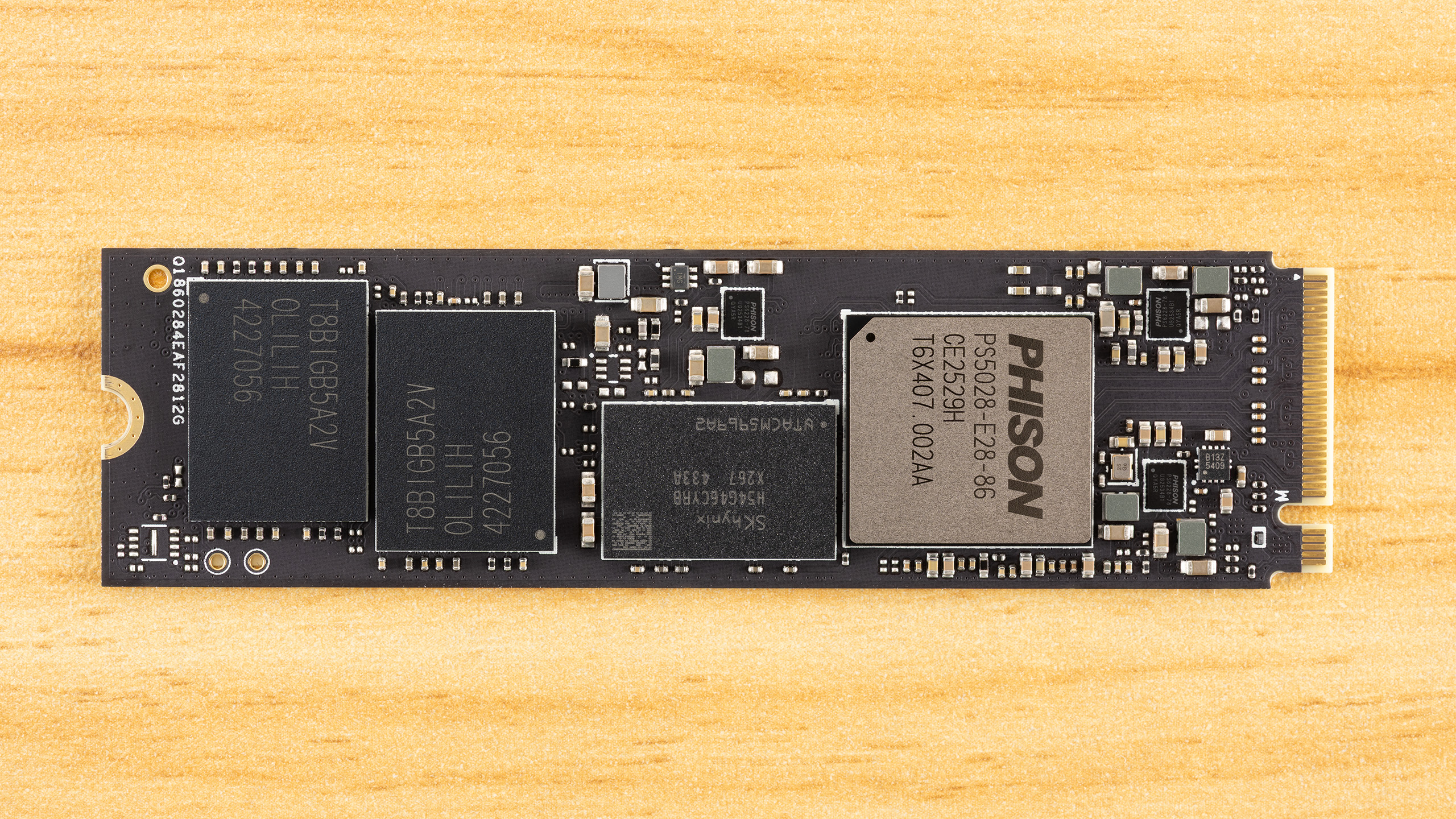
The 2TB Corsair MP700 Pro XT is a single-sided drive, which is definitely something we like to see. Some of the drives in this segment, like the Adata XPG Mars 980 Blade, are double-sided, which can complicate drive fit in some systems and make them more difficult to cool. It looks like the 4TB version of the MP700 Pro XT is also single-sided, given that it has the same dimensions as the 1TB and 2TB. Given the power numbers from Corsair, we think this drive will work without a heatsink and should be fine in a laptop, so this single-sided form factor is great.
Speaking of power numbers, the label indicates a 3.3V, 2.4A power rating. This ballparks a peak around 8W, but the drive is rated for 6.5W active draw at 4TB, and the top power state is also 6.5W. This suggests Phison has managed to make an even more efficient controller than SMI’s SM2508, which is quite the accomplishment. It’s certainly an improvement over its older E26, which will make some readers happy.
The MP700 Pro XT has an SSD controller, a single package of DRAM, and two NAND flash packages. Also on the board are Phison’s power management chips. This arrangement is the same as that on the Phison E28 ES, which we previously previewed, and it certainly contributes to its high power efficiency. Other configurations include discrete and on-ASIC power management, and all three arrangements have their pros and cons. The solution used here does take up some PCB space and may add cost to the drive, but there’s no arguing with the results, especially as this is a single-sided drive.
More details on the controller are available in our original preview. The pertinent details are that this is an eight-channel solution that can use newer ONFi/Toggle 5.2, or 3,600 MT/s, flash. Technically, this controller is rated for up to 4,200 MT/s in a four-channel configuration – previously, the Kioxia Exceria used the four-channel E12C variant of the E12/E12S for extra power efficiency – and up to 3,200 MT/s for the full eight channels. This is plenty of bandwidth to saturate the PCIe 5.0 connection. It can also use its choice of DRAM with the MP700 Pro XT, relying on SK hynix LPDDR4X, which is an efficient way to go.
The flash on hand is Kioxia – the “T” in the code points to its Toshiba origin – with 8Tb or 1TB packages using 218-layer TLC. This flash has proven to be excellent in our testing, with the best random read performance on record. The SanDisk WD Black SN8100 is a good example of what this flash can do. We’ve pointed to the agile, four-plane design as one factor for this performance, although it is the architecture as a whole – with sub-planes for responsiveness – that gives it a unique leg up over Micron’s 276-Layer flash on the Crucial T710. The MP700 Pro XT can also deliver maximum bandwidth thanks to optimizations for the E28 controller.
